
Days of Euphoria in Matanzas.
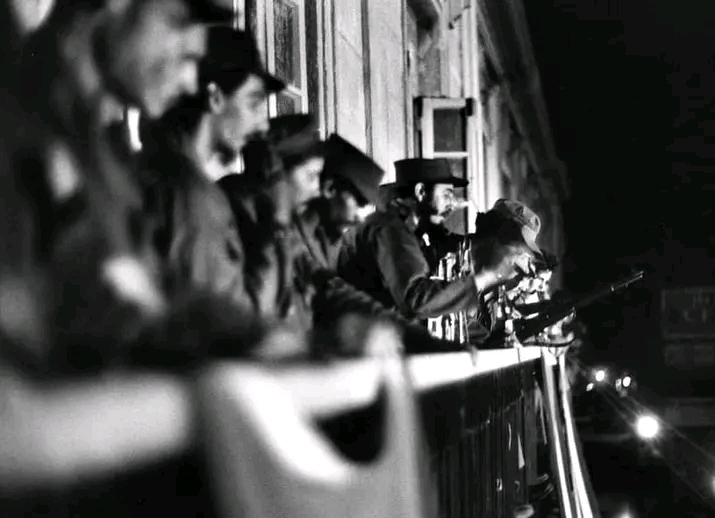
Fidel Castro Ruz, Commander of the Cuban rebeld army, spoke with the residents of Matanzas for two hours and twenty minutes. He learned firsthand what the people of Matanzas needed most urgently. The plan to subdivide and sell the land of the Palmar de Junco stadium was resolved, and that same night, he ordered a solution to the problems with the city’s aqueduct, which was in very poor condition.
To an event that shook the town of Matanzas and to a dear friend who knew how to uncover the hidden details of history. To the memory of Arnaldo Jiménez de la Cal, forever grateful.
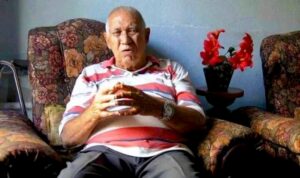
My interviewee possesses two undeniable and highly relevant virtues: first, having participated in the historical event I am attempting to describe, and second, due to life’s twists and turns, holding the title of Doctor of Historical Sciences, earned fairly in Bulgaria some years ago.
The Days of Euphoria
Although his eyesight fails him, this impediment strengthens his memory, and how! For although he tries to present the events from the usual academic perspective, he finds it impossible to escape the multitude of emotions that grip him from his home on Capricho Street, high above the city, where his sometimes measured, sometimes vibrant, speech reveals to us, in a striking cinematic sequence, the euphoria of the Matanzas residents in the early days of January 1959.
Three Moments Before the Caravan Passed By.
From the early morning of January 1st, members of the 26th of July Movement (MR-26-7) and other organizations committed to the Rebel Army, supported by the man from Matanzas, seized the police headquarters, arrested the bloodthirsty Captain Salas Cañizares, and freed the detained revolutionaries.
The 41st Squadron of the Rural Guard met the same fate, while the Plácido Regiment was taken by Camilo Cienfuegos on January 2nd, and its command was transferred to Captain William Gálvez.
In this context, the joy was interrupted on January 5th, when the Granma expeditionary, Matanzas native, and Rebel combatant, Commander Horacio Rodríguez, was buried in the city cemetery after his assassination in Manzanillo.
Arnaldo, these are, in short, three of the most important events of those days in Matanzas. However, for the historian and participant, what impressed you the most?
AJC: Several aspects caught my attention: first, Fidel’s willingness to have direct contact with the people from the moment he entered Matanzas. Fidel spoke with the people in Perico, Colón, and Jovellanos; and even at the event here in the city, where he complained about being on the balconies of the old city hall, so far removed from the population.
He spoke with the people of Matanzas for two hours and twenty minutes. He learned firsthand what the people of Matanzas needed most urgently. He resolved the plan to subdivide and sell the land where the Palmar de Junco stadium stood, and that same night, he ordered that the problems with the city’s aqueduct, which was in very poor condition, be resolved.
Interestingly, this is the only instance where he slept outside the route he was following, that is, the Central Highway.
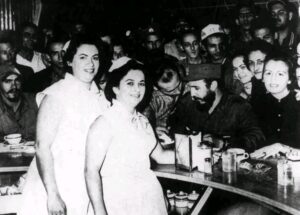
Let’s remember that after the event in Matanzas, he met with leaders and attended a press conference with foreign journalists, and from there he traveled to Varadero. He slept at the Hotel Internacional, in room 543, and then traveled to the city of Cárdenas. This was the only time during his journey that he stopped to see someone, in this case, the mother of José Antonio Echevarría.
He arrived early in Cárdenas and met with her for more than two hours in a private meeting, about which no information was released.
Another point to note is that in Matanzas, Fidel separated from the Caravan of Freedom with a small escort and Celia Sánchez to visit Varadero and Cárdenas. He then returned to Matanzas and rejoined the column to continue its journey to the Cuban capital.
Q: And in the days leading up to the Caravan’s passage, what happened in Matanzas?
AJC: You already mentioned the most important ones, but on January 2nd, Camilo, following Fidel’s instructions, passed through our city and forced the surrender, completely unarmed, of the 4th Plácido Regiment, which had considerable logistical and military capabilities to confront any revolutionary activity.
Camilo appointed then-Captain William Gálvez to lead the regiment. At one point, an officer of the dictatorship asked Camilo how the bearded revolutionaries were going to lead an organized army, to which Camilo replied: “In the same way that army lost the war against us, who are guerrillas.” He then continued on to Havana to occupy Columbia.
Just a few hours later, Che Guevara passed through, confirming William Gálvez as military chief in Matanzas and at the telephone workers’ union, which was located in the alley of San Severino. Che shared time with the people of Matanzas until he left for the Río Mar hotel, upon learning that some followers of Mansferrer had started a shooting.
Once the incident was resolved and those involved were disarmed, the journey continued toward Havana to occupy La Cabaña fortress.
I’m telling you this so you understand that the people of Matanzas were aware of these visits and how deeply they experienced them. They were events that fueled euphoria—yes, that’s the word: euphoria. Q: And how did the people of Matanzas react to the approaching Caravan?
AJC: The revolutionary enthusiasm of the people of Matanzas was immense. They closely followed Radio Rebelde and the national network of stations that broadcast the route of the caravan, which would enter Matanzas on the 7th.
Although people didn’t know what time it would enter the city, they gathered very early in the morning at Liberty Park and remained there until well into the night, when the meeting with Fidel took place. He gave a lengthy speech that lasted until the early hours of the morning.
Q: By the way, the transcript of Fidel’s first speech in Matanzas is preserved. Do you have any information suggesting that a description of the press conference he later gave to local and international journalists is available?
AJC: At least I’m not aware of any details of that meeting. It’s possible that someone from Matanzas might have the material about that moment. Because the Matanzas press of the time didn’t offer any details of that meeting. We did, however, have information about the speech in Liberty Park, which we were able to study.
Q: Any interesting details, Arnaldo, about Fidel’s visit to Matanzas on January 7th, 1959?
AJC: In that meeting with Fidel in the city of Matanzas, the idea of building a monument to the Matanzas martyrs who participated in the Moncada attack, the Granma expedition, the Sierra Maestra, and the underground struggle was proposed.
And Fidel agreed, but then added that the best tribute to all of them would be the work of the Revolution itself. Those were days of true euphoria.
Written by José Miguel Solís.