

Memoirs of Three Unforgettable Loves.
517384406
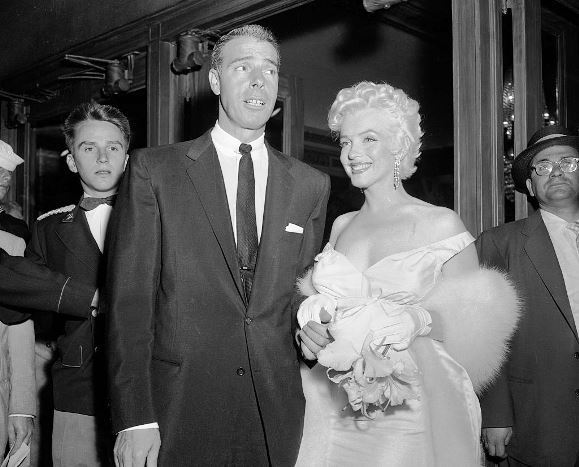
When Marilyn Monroe died on August 4th, 1962, Joe DiMaggio made sure that for 20 years she received half a dozen roses at her grave three times a week.
First Love:
Considered the most complete hitter of his era (1935 to 1951) in Major League Baseball, with the New York Yankees, Joe DiMaggio became an idol to huge crowds when, in 1941, he set a record that still stands of 56 consecutive games with a hit.
In thirteen seasons with that team, he had a batting average of .325. He served as a combatant in World War II, which caused him to miss three years of playing. His name appears in the Baseball Hall of Fame in Cooperstown, among the Immortals.
He was a player of great catches, according to journalist Leslie Rodriguez, and one off the field, when he won the heart of one of the most coveted women of those years, actress Marilyn Monroe, whom he married in 1954. He was always in love with her.
When the celebrated actress, singer, and dancer died on August 4th, 1962, Joe made sure that for 20 years she received half a dozen roses at her grave three times a week. He never remarried. In addition to being a distinguished baseball player, he was an elegant lover.
Second Love:
Another difficult love, due to the circumstances they faced, was that of the Cuban boxer Evelio Mustelier, known in the sports world as Kid Tunero, and the Frenchwoman Yollet Yol.
Evelio was born in Las Tunas on May 19th, 1910. He began boxing very young in Banes, Holguín province, before moving to Havana, where he won many fights in the light heavyweight division. At 21, he moved to Barcelona, Spain, where he settled and met his future wife, with whom he lived for a time in France.
In his career, he won 111 fights, 35 of them by knockout. Among his victories were four against world champions.
At the start of World War II, the Cuban was outside Paris, where he had left his wife and two children, who were interned in a concentration camp by Nazi troops.
He spent four years trying to contact his family, without any news, remaining faithful to Yollet, hoping she was still alive with their children. At the end of the war—fortunately—he found them and decided to move to Cuba, where he stayed for a while and even fought his last bout in 1948 in Havana against the Panamanian Harrong Barrows, whom he defeated.
They decided to return to Barcelona, where he dedicated himself to training professional boxers. He died in Barcelona on October 9th, 1992, and his remains rest next to those of his wife, Yollet: the love of his life.
Third love:
Basilio “El Brujo” Rosell was a prominent right-handed baseball pitcher who was born in the town of Los Arabos in Matanzas province in 1902 and died in Mexico City on November 15, 1994.
He had a long and distinguished career in the sport, beginning in the 1920s, playing professional baseball in Cuba, the Negro Leagues, and primarily in Mexico, where he had his best performances, to the point that his name is enshrined in the Mexican Baseball Hall of Fame.
During his time playing for the Cuban Stars, on a visit to St. Louis, he was struck by Cupid’s arrow, as explained in his remarkable book, *La Gloria de Cuba* (The Glory of Cuba), by Roberto González Echevarría, a Cuban professor at Yale University, based on a book of interviews by the Mexican journalist Cristina Pacheco.
In that city, Basilio met a young and delightful dancer named Josephine, who would later become Josephine Baker. The attraction was mutual, and they had a romance. Years later, already a star, Josephine was in Mexico City, and «El Brujo» (The Wizard) appeared, had himself announced, and was taken to the dressing room.
As the Cuban recalls: «We stood looking at each other, motionless, and I don’t know why, we both simply started to cry… Perhaps in that encounter we realized that time had passed… We never saw each other again. Her death hurt me. I loved her very much: she was so beautiful!»
Written by Francisco Soriano.