

The Nonagenarian Energy of Ofelia Tamayo.
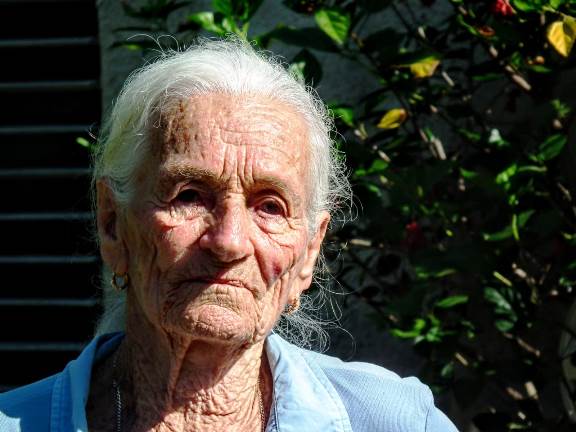
Meeting Ofelia, listening to her speak, invites one to revere lives like hers, marked by joys and sorrows, but above all by that extraordinary desire to live and fight, always in a constant struggle with time, in which she will have the advantage because she has tireless energy, even though she has already reached 93 years of age.
Ofelia Tamayo walks with such agility, as if she were determined to outpace time and leave it in its wake, always one step ahead. The minutes seem to bow before her, unable to match the rhythm of this nonagenarian woman, who, at first glance, could be described in many ways, but never as elderly.
Although her hair has turned as white as the clouds that appear high above the Yumurí Valley on certain clear days, and the same mist that hangs over her blue eyes as a harbinger of summer from her doorway settles upon them, no one would believe that this industrious farmer has just turned 93.
With a light gait, like a skittish bird, her words emerge from her with the eloquence of someone who, having lived so long, knows all of life’s secrets; her gestures denote an enviable vitality that knows neither weariness nor rest. From early morning, she begins her busy work on the farm, very near Chirino, in the Yumurí Valley. Before getting out of bed, he exercises his limbs a little.
Especially since that time he bent down to look for a shoe in the shoe rack and felt a sharp pain in the legs that have supported him in this world for over 90 years. It was then that he decided to do push-ups as a warm-up for the tasks that awaited him during the day.
“I’ve worked hard in my life,” she says, and you understand that the whirlwind she becomes will never stop. She sweeps with unusual force to cover every inch of her property, whether searching for eggs from the chickens she raises or trying to fill the gaps in the fence that marks her land.
You can still see her, machete in hand, clearing the banana grove or using a hoe to weed the area around her house to prevent weeds from growing. Ofelia laughs from the heart when she speaks and mentions death casually when referring to her own. With a playful smile, she says she’d prefer to leave this world all at once, “like that, happily, without suffering,” and lets out a laugh while “touching wood” as if to ward off bad omens.
She says she couldn’t bear to be inactive in bed, that her nature is to be constantly moving, always finding something useful to do.
That’s how she was as a child, and even though more than nine decades have passed, she hasn’t lost that youthful vitality. *********
Ofelia Tamayo was orphaned at the age of five. As a young girl, she took charge of the household, helping her father raise her siblings.
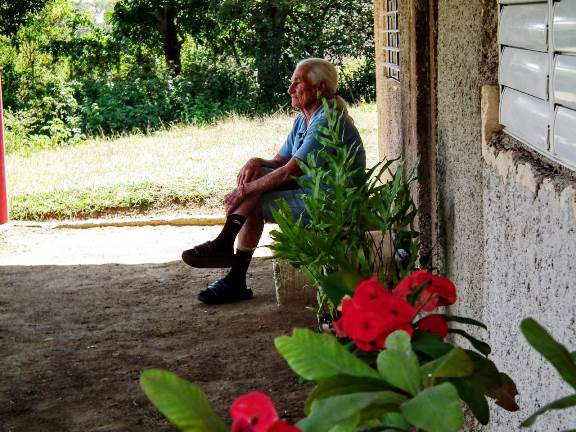
While other children were still playing with dolls, she would climb onto a crate to reach the rustic wood-burning stove.
Alongside her father, she learned the hard work of the fields. She could be seen one day building a thatched hut, the next harvesting and shelling corn.
Later, she married and started her own family in Baire, Holguín province, where there are still people who remember her hard work.
She performed countless tasks as a cook for a military unit, while also taking on various responsibilities in mass organizations such as the Committees for the Defense of the Revolution (CDR) and the Cuban Women Federation(FMC).
******
In her living room rests a Singer sewing machine, inherited from her grandmother, which is over a century old and still responds to her touch of the pedal to move the pulley.
With this machine, she supported her children and became a well-known seamstress, frequented by dozens of neighbors. She specialized in men’s clothing.
With a playful look, she recalls that women, when trying on a newly altered garment, sometimes demanded attributes their own bodies lacked. And she was a seamstress, not a magician, she clarifies, bursting into infectious laughter. Sewing was her greatest expertise, and it was how she supported her family financially.
She continued sewing until very recently, when she began to experience severe fatigue from focusing her eyes for so long. Although she does fewer alterations on her old Singer, she has no intention of parting with it. She keeps it in a place of honor in the house, right in the living room.
Ofelia herded sheep for years, but the increasing theft by bandits forced her and her daughter to sell the animals. For now, she has the chickens and bananas she manages to harvest from her plantation.
****
There are pains that lacerate the soul, and Ofelia’s heart faced one of the most devastating blows of her life: the loss of a son.
Her eyes still well up when she remembers him. Time has passed, and when I think of him, I feel the deep emptiness that wounds her inside. In a corner of the patio, they built a small shrine where she places flowers for her loved ones. It’s the way she found to honor her dead and keep them alive in her memory.
Fortunately, the joyful noise of her grandchildren and the arrival of twin great-granddaughters help her forget the sharp sorrow she suffers.
Despite the company of her daughter and granddaughter, a pediatrician, who live with her, and the care and affection shown to her by so many loved ones, sometimes she remains silent, gazing at the horizon. It’s the pain that returns, but she has learned to bear it with a certain fortitude.
******
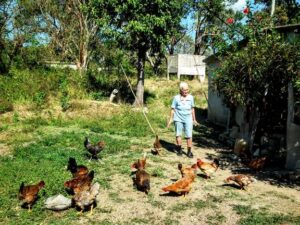 Ofelia is one of those women who become indispensable wherever they settle. Whether in Cacocún, where she was born, in Baire, where she started her family, or in the Yumurí Valley, where she has lived for many years, she has always been a kind of matriarch to whom many turn for a remedy or a word of encouragement.
From a young age, she learned to cure indigestion, a practice she inherited from her father. She has cured many children of overeating by massaging their legs. It’s a kind of mysticism that enhances her legacy, even though she doesn’t seek to create a special kind of being. But this woman does possess something wonderful, captivating anyone who hears her speak candidly about beauty and the divine.
She is like that coffee whose aroma invigorates, a coffee whose essential morning sip she never misses. Meeting Ofelia, listening to her speak, invites one to reverence lives like hers, marked by joys and sorrows, but above all by that extraordinary will to live and fight, always in a constant struggle with time, in which she will have the upper hand because of her tireless energy, even though she has already reached 93 years of age.
Photos by the author
Written by Arnaldo Mirabal.