
Urbano Martínez Carmenate and his devotion to history.
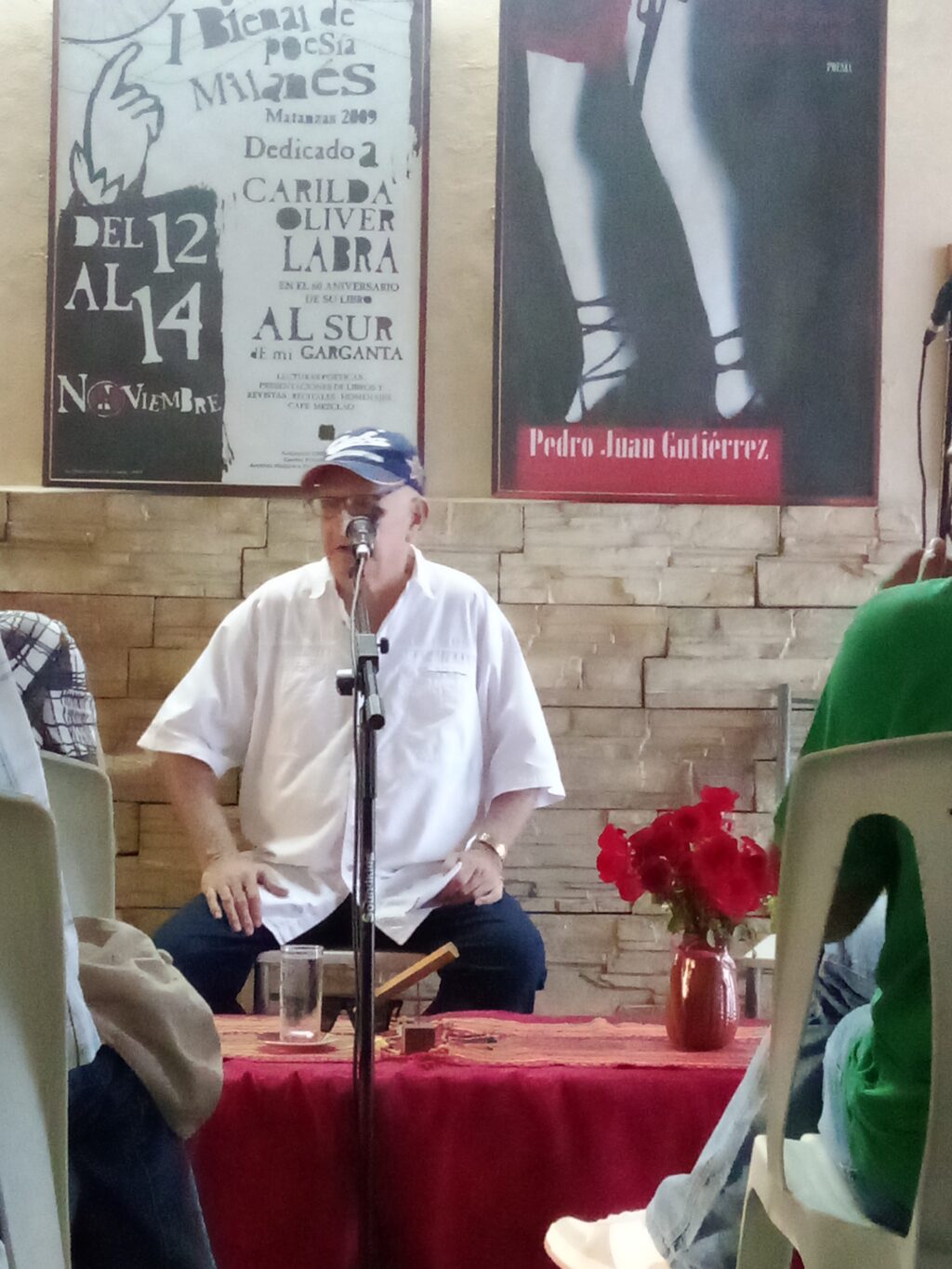
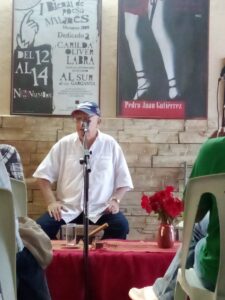 Some time ago, I attended a lecture at the Bonifacio Byrne Cultural Center in the city of Matanzas. It was a presentation commemorating the anniversary of Carilda Oliver Labra’s birth, given by her biographer, the Matanzas-born essayist, historian, and researcher Urbano Martínez Carmenate.
I was interested in the topic and the speaker, especially after reading *Carilda Oliver Labra: Poetry as Destiny*, by this prestigious intellectual. That interesting and insightful discussion about one of my favorite writers exceeded all my expectations.
The man, who supported his remarks with a few handwritten notes, spoke in clear and simple language, showcasing his encyclopedic knowledge, the passion with which he approaches each of his research projects, and his skill as a communicator.
His undeniable diligence has resulted in nearly thirty texts, including biographies of notable figures in Cuban and international culture.
Carpentier, the other novel, one of your most recently published books, has also been for you “the most painful and laborious.” How much had to happen, how much time had to pass before it saw the light of day?
“I started it around 2000 or 2001 and finished it between 2018 and 2019. Five years passed, and it was published in 2024, so it’s been quite a long journey with many obstacles and difficulties.
“First of all, when I started it, Lilia Esteban, Carpentier’s widow and literary executor, was still alive. At one point, she objected, even though the Alejo Carpentier Foundation had recognized the project with the Razón de Ser Award. She said I couldn’t do it because I wasn’t a musicologist, among other things, which made me put the project on hold for a while.
“I finished a first version. After her death, I started a second and finally a third, incorporating all the documents that were at the Foundation, whose director, Graciela Pogolotti, took over. She did help me passionately.
“For all these reasons, it’s a very poignant book, and the editing and the process were very difficult.” It was all difficult, it’s a long story, but thankfully the results speak for themselves.
I know from everyday experience that you should never ask a parent about their favorite child, but this time I’ll take the risk. Among the books he’s written, does Urbano have a favorite?
“I think I’ve said this before. It’s very difficult to choose between my children. I could tell you a few things that have nothing to do with my personal preference. For example, Domingo del Monte’s is the most awarded, the most recognized, both nationally and internationally; Milanés’s is the one that brings me the most sadness, and I identify with it a lot; Byrne’s was the first; and Carpentier’s was the last.
“It would be very difficult for me to choose between them because I’ve done them all passionately, with great love, with great dedication. I’ve tried to put the best of myself into each one. Some have turned out better than others, of course.”
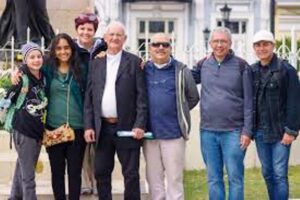
“Look, when I wrote Nicolás Heredia’s biography, I thought it was necessary because he’s one of our best novelists of the 19th century. Leonela is considered one of the most important novels of that era, along with My Uncle the Clerk and Cecilia Valdés.
“Secondly, because he had lived most of his life in Matanzas, and it was worthwhile to highlight him for those reasons. I thought he would be a simple character, but when I began to research him, the complexities were enormous, including his relationship with Martí and other issues that simply made him an incredibly complicated character. I surprised myself with that; these are experiences one has as a creator.”
How did you come to write about the lives of great personalities? You mentioned that your first biography was of Bonifacio Byrne. How do you choose your subjects?
“The first biography was of Bonifacio Byrne, and it went through three versions.” The first edition was immensely long, the second later won the biography prize in the Primero de Enero competition, and the third was published in 1999. After that, I wrote another book called Byrne, the Verse of the Homeland, which is the one I still consider definitive.
“I entered the Palacio de Junco as a researcher. I tried to research something related to literature, which is what I studied. I have a degree in Philology, specializing in Latin American Literature. There was a very extensive and interesting collection there on Bonifacio Byrne.”
“Since I was working in a primarily historical museum, I was determined to write his biography. It wasn’t a literary study, but a biography of the poet, because there wasn’t a comprehensive, in-depth, complete biography available. Later, I was motivated to write Milanés’s as well.”
We can’t help but talk about his work as a researcher at the Junco Palace Museum. Valuable publications related to the history of Matanzas have come out of there, and he was already telling me about those early days…
“My work has always been highly valued, very well received. When I’ve told some friends this, they’ve said: ‘Of course, you’ve earned it,’ and I reply: ‘It’s true that I’ve earned it, but well, there could be cases of someone who earns things and isn’t recognized for it.’
“They’ve always recognized me, they’ve always listened to me, they’ve always made my work easier. There came a point when they told me, ‘We’re going to take away your work table because it’s better for you to work from home.’”
“There were times, in the 1980s, when I worked 15 days a month in Matanzas and 15 in Havana. All of that was supported and funded by the museum. I have always felt, and continue to feel, very satisfied with the museum.”
How much does biography differ from other genres in terms of writing resources? How much does it take to create a good biography?
“I don’t think there are, for example, major differences between the essay, the monograph, and the biography, other than the focus on the subject. There shouldn’t be any differences in language.”
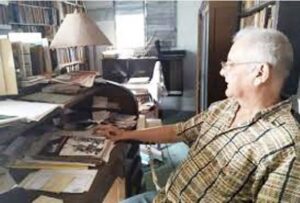 A monograph studies a topic in depth, trying to leave no stone unturned; a biography does the same, only it focuses on a single person; an essay is somewhat broader, or narrower, depending on how you look at it—it’s freer, I would say.
“For example, my book Fray Candil is an essay, not a biography. In it, I indulged myself by writing whatever I wanted, going off on tangents as I pleased, and leaving out what I felt shouldn’t be there—that’s not the aim of a biography.
“Biography attempts, though it doesn’t always succeed, to tie up all the loose ends and clarify most of the facts, but ultimately, some people have considered the biographies I write to be essayistic biographical studies because I’m not the kind of biographer who simply describes, but rather one who questions, reasons, conditions, seeks answers, and interrogates the subject himself.”
How do you assess historical research in Matanzas today?
“My opinion is terrible, very bad. It’s not that research isn’t being done, but certain people shouldn’t be the way they are. I mean, it should be like it was in the 80s and even a little in the 90s, when there were many people working on research.
“Of course, the responsibility for this doesn’t lie with the individual, but with the country’s situation, which is very difficult. So, you have to consider that, first of all, to do research in a municipality, you have to go to Matanzas, and to do research in Matanzas, you have to go to Havana.
“Undoubtedly, the National Archives, the National Library, the Library of Literature and Linguistics, and Casa de las Américas are essential places for working on any topic.
“Everything is very difficult; you can’t ask people to do research, except for those who are dedicated, who never stop, like Mireya Cabrera, Ercilio Vento, or Clara Emma Chávez in Matanzas; An Ernesto Álvarez Blanco, in Cárdenas, faces many difficulties, but they manage because they also have other resources, but in reality, research is in a very depressed state.
Urbano, your numerous awards are the result of a life dedicated to writing, research, your talent, and your effort. I’d be more interested in knowing, rather than listing them, what has been your greatest joy, the greatest reward you find in writing?
Awards always bring surprise and joy because they are public recognition of one’s work. I won’t say that awards mean nothing to me, but what’s most important to me isn’t the awards, but the work itself.
«My greatest satisfaction comes when I see, connect with, and experience that both an intellectual and an ordinary person stop me and say, ‘I read your book, I loved it, I learned so much, keep writing like this.’
«For me, that act has tremendous value because I don’t write only for intellectuals; I write for the people as well. I try to do it in the clearest language possible because I want the common person to read the biographies too.»
Written by Jessica Mesa