

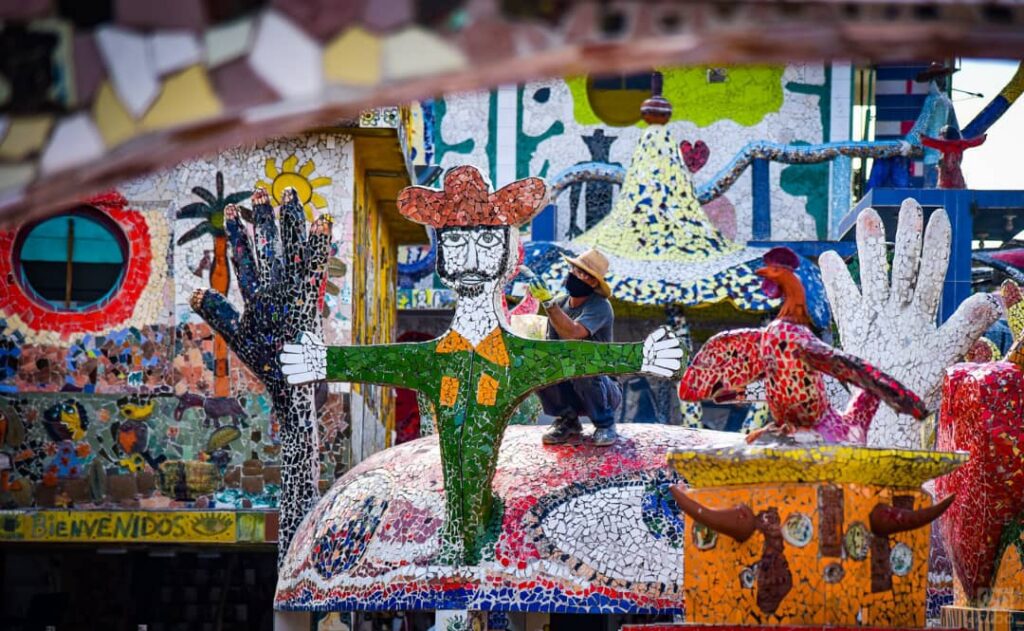
Although the legacy of the most important visual artists in Cuba endures, a new generation is emerging. This generation is full of critics and curators, with new approaches and management dynamics.
Cuban visual arts today stand as living testaments to the changes that took place on the island after the revolutionary triumph in 1959, and they have become more sensitive as a result of the new cultural and artistic projection of the process.
Each of the expressions that arose during that period proved receptive due to the movement so closely connected to humanity and the new paths of history.
Cuban visual arts encompass painting, ceramics, printmaking, photography, architecture, and graphic design created within the country. These are part of the diverse aesthetic conceptions brought to the island by Spanish colonizers and enslaved Africans.
The earliest manifestations in Cuba are found in indigenous villages, with artifacts such as clay pots and petaloid axes made of symmetrical stones.
In the 16th century, Cuban painting was considered a trade, and artists were paid for their portraits, which were the most common subject. Nicolás de Escalera, Francisco Javier Báez, and Cirilo Villaverde were among the Cuban painters who captured the luminosity of native art a few centuries later.
It wasn’t until 1925 that Cuban art was incorporated into the framework of contemporary art, with prominent figures such as Víctor Manuel, Amelia Peláez, and Wilfredo Lam, whose works highlighted the beauty of the Cuban countryside and life itself.
Closer to the present day, the artist began to act as a theorist and analyst of his own work, always striving to bring art to the streets and make it accessible to the masses and the public through the use of any expressive means that could realize the creator’s conceptual objectives.
Although the legacy of the most important visual artists in Cuba endures, a new generation is emerging. This generation is full of critics and curators, with new approaches and management dynamics.
Art is nothing more than a reflection of human culture. It acts as a means to preserve a people’s cultural heritage and as a means of expression to transmit a universal language, perceptible to any individual by appealing to the senses, emotions, and ideologies.
Written by Lizt Lauren Hoyos.