

The vicissitudes of Matanzas’ only suspension bridge (+photos).
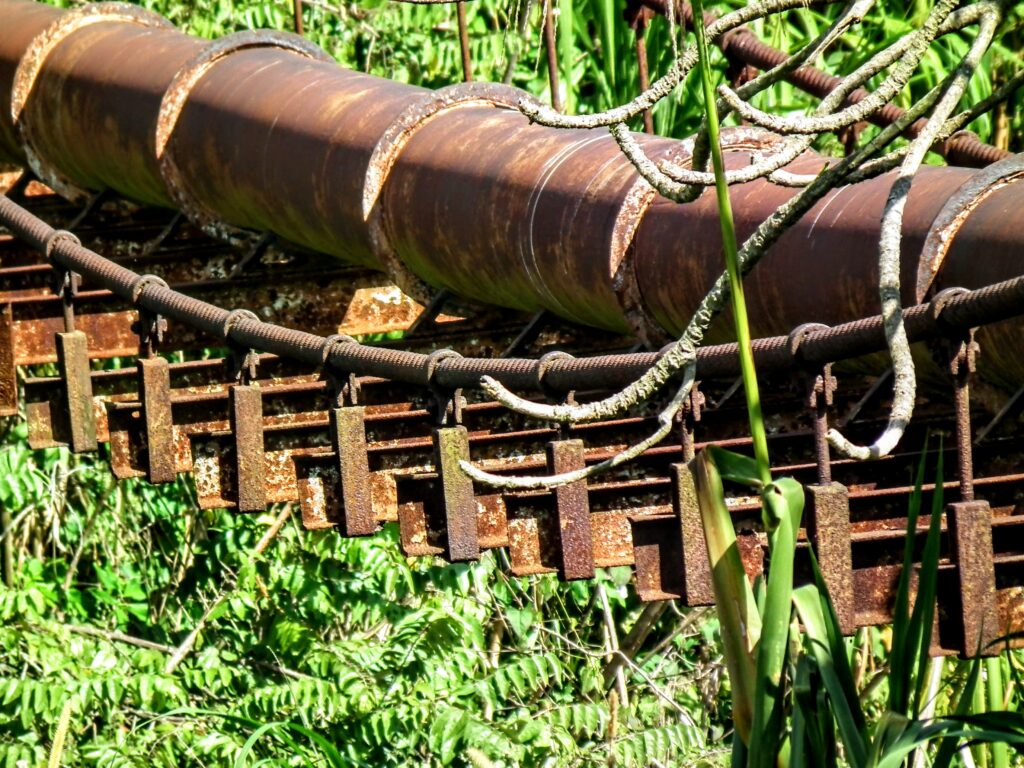
Hidden among the vegetation, the suspension bridge over the San Agustín River resembles a kind of mirage that only becomes visible at certain times, while at the same time it can become imperceptible to the eyes of mortals, especially when they are unaware of its prominence and importance in the historical development of the city.
Hidden among the vegetation, the suspension bridge over the San Agustín River resembles a kind of mirage that only becomes visible at certain times, while at the same time it can become imperceptible to the eyes of mortals, especially when they are unaware of its prominence and importance in the historical development of the city.
Very close to this structure is a well-known pool called El Conde, visited by hundreds of Matanzas residents, perhaps unaware that with just a little closer inspection they can appreciate one of the most important architectural gems built in Matanzas.
If in the past, 153 years ago, hundreds of inhabitants of this region attended its inauguration despite the relative distance between the city center and the site, today the structure languishes almost forgotten and completely abandoned.
Being the only steel suspension bridge with curved cables built in Cuba has not saved it from cruel neglect or the rust that is slowly destroying it.
It should be a must-see site, both for the city’s inhabitants and for foreign visitors, to showcase with healthy pride the ingenuity of the people of this land, with their ability and drive to create a marvel of such relevance in the national architectural history.
Birth of a project.
In the mid-19th century, the inhabitants of Matanzas urgently needed an aqueduct to receive the water necessary for their basic needs.
Numerous projects were presented to the City Council. Even prominent names like Francisco del Albear appear among the documents that compile the various studies submitted to promote the civil engineering project.
These studies, according to the research consulted, proposed the San Agustín River as the water source. This, it is explained, was the main reason for the failure of each attempt, as the river suffered from low water levels and water pollution during those years.
It was then that the name of a Mexican entered the scene. He was the civil engineer Juan Francisco Sánchez Bárcena, based in Cuba, who promoted and executed one of the most revolutionary hydraulic and engineering works of the era.
Starting in 1859, the Mexican undertook the task of exploring the region’s main springs, a move that distinguished his project from previous ones.
He located and analyzed thirteen springs, ultimately choosing a system of wells located on Gregorio Bello’s property.
A year later, Bárcenas presented the results of his analysis with a meticulous plan based on topographical and engineering studies.
Construction of the Aqueduct began on September 15, 1871.
Just ten months later, with the great hydraulic work completed, the residents of Gentil Yucayo joyfully witnessed water beginning to flow from a large fountain in the middle of the Plaza de Armas.
Initially, the aqueduct was named Burriel, in honor of Juan Burriel, the city’s governor, who vehemently supported its construction.
Suspension bridge: unique of its kind in the country.
For Bárcenas, the construction of this bridge represented the most important work in the aqueduct’s construction process. Its construction would allow the 15-inch water pipe to be supported over the San Agustín River, thus connecting the springs of Bello with the city.
This important structure was the result of the Mexican engineer’s design, and contrary to what some claim, his inspiration was not the Brooklyn Bridge, but the Niagara Falls railway suspension bridge.
«This structure is the only surviving suspended cableway of its time in Cuba,» asserts civil engineer Maikel Pérez Díaz in an in-depth study conducted as part of his thesis. And without a doubt, it is one of the country’s most emblematic bridges, and the oldest preserved in the province.
Although it ceased to be operational in 1987 with the construction of a new power line, its remarkable beauty, technological significance, and historical importance could make it a tourist attraction.
Attempts to Save the Suspension Bridge
In 2012, Maikel Pérez, a young student at the University of Matanzas Camilo Cienfuegos, chose the rescue of the suspension bridge as the topic of his Civil Engineering thesis.
Under the title «Proposal for the Rehabilitation of the Suspension Bridge over the San Agustín River,» he delved into the history of this structure and analyzed its technical condition from his field of study.
His research revealed the serious damage caused by lack of maintenance and marked neglect. Even so, the student surely had his thesis, and the hope, that once he presented his findings and recommendations, the fate of the suspension bridge would change. But that wasn’t the case; quite the opposite, in fact, because 13 years after his research efforts, the situation has worsened.
Weeds have taken over the iconic towers, which are now barely visible, and corrosion advances relentlessly across every inch and element of the structure.
Yet, despite the neglect and abandonment, it emerges impressively when it stands majestically over the waters of the San Agustín River.
Then it ceases to be a kind of mirage or a mere, sporadic mention in some article, and assumes the true dimension of its existence: one of the most important centennial bridges in the City of Matanzas, and the only one of its kind that still exists and endures in the country.
Photos: By the author
Written by Arnaldo Mirabal.