

Tension in the Caribbean: Echoes of a Persistent History.
And although the winds blow strongly from the north, there are deep roots that sustain the hope for a different future, where mutual respect replaces intimidation and where peace depends not on the caliber of cannons, but on the strength of principles.
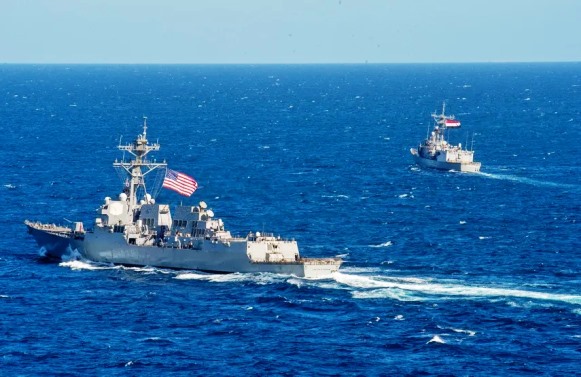
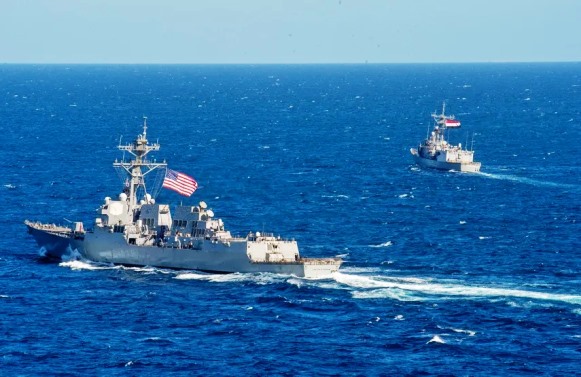
The recent redeployment of US military forces to northern Cuba, following the operation that culminated in the capture of Nicolás Maduro in Venezuela, has reignited old tensions in the Caribbean. Although presented as a strategic maneuver for regional containment, this action resonates with historical echoes that cannot be ignored.
The presence of warships in nearby waters is not an isolated event, but rather part of a broader narrative of pressure, surveillance, and power projection that has characterized hemispheric relations for over a century.
In this context, geography once again becomes a defining factor. Physical proximity to the United States has been both a blessing and a burden for decades. The waters of the Caribbean, which should be a symbol of exchange, culture, and shared life, are transformed into a stage for military maneuvers that raise legitimate concerns.
It’s not just the threat of direct intervention—which has been officially denied—but the implicit message sent by the concentration of military power in a region historically subject to intervention. History teaches us that military movements in the Caribbean have rarely been innocuous.
From the occupation of neighboring countries to the Cuban Missile Crisis, the region has been used as a chessboard by external interests. Every deployment, every ship, every bombastic declaration, is part of a logic that prioritizes domination over dialogue, imposition over cooperation. And although times change, the forms of pressure adapt, but they don’t disappear.
The operation in Venezuela, beyond its internal implications, has been used as justification for extending a military presence that inevitably affects neighboring countries. The narrative of fighting drug trafficking or defending democracy has been used before and has often served as a pretext for actions that have little to do with the interests of the Latin American people.
Sovereignty, that principle so often invoked and so often violated, is once again at stake. In this scenario, the response cannot be silence or resignation. The region has demonstrated, time and again, its capacity for resistance, its commitment to peace, and its right to decide its own destiny. Faced with these displays of force, the dignity of those who have chosen a different path rises up, with their successes and failures, but with the conviction that self-determination is non-negotiable.
The Caribbean is not a strategic vacuum, nor a space to be filled with ships and threats. It is a community of nations with history, culture, and will. And although the winds blow strongly from the north, there are deep roots that sustain the hope for a different future, where mutual respect replaces intimidation and where peace depends not on the caliber of cannons, but on the strength of principles.
Written by Yannier Delgado.