
Maylan Álvarez: Matanzas Is the Stage of the Staging That Is My Life
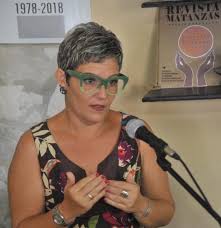
Many connoisseurs of the subject catalog her as a continuator, a staunch defender of Carilda Oliver Labra’s work. Although she herself denies any proximity to the literary height of the Bride of Matanzas, in her lyrics one can perceive influences of the National Literature Prize winner through the themes she addresses and the beauty with which, from simplicity and everyday life, she addresses women’s realities.
Her work also reflects a bit of our own lives, full of lights and shadows, conflicting feelings, uncertainties, and, above all, much love.
Naufragios del San Andrés was born from the need to bring to the foreground the land where you were born. How does Unión de Reyes fit into your work in general?
I am a Unionense from Reyes. I will always have my town with me, deep in my chest, and that of course is part of my poetics because, as a country woman after all, I believe roots are the most important thing, they are part of your DNA, and Unión de Reyes is in me.
My first poetry book, which won the Calendario prize, is precisely dedicated to the voices of Unión de Reyes, to its people. There was a moment of misunderstandings, but time heals everything, or almost everything.
People thought I was attacking people through some poems. Not at all — it is my homage. I should have changed some names at that moment, moved some anecdotes, because really almost all of them are true stories that came to me from my great-grandmother, from my grandmother, and survive in the popular imagination of Unión de Reyes; others, products of my imagination.
I believe that even God rewards innocence, and I am still asking for forgiveness publicly for the misunderstandings, but I love my town and it will always be in my poetry.
See also: https://oncubanews.com/opinion/columnas/de-otro-costal/maylan-alvarez-busco-poetizar-todo-lo-ordinario/
The description of your closest realities is a constant in your work, and many of them coincide with those of your readers. Do you think that being a journalist has led you to be a chronicler in your poetic work?
I am gradually leaving journalism behind a bit. I believe there are many excellent people doing it in the province right now, others not so much. I think more criticism and post-criticism need to be done in journalism, even making it more dynamic, but I am leaving journalism more to the side because editing takes up my time.
What motivates you most about your work as an editor? How does being part of a publishing house like Matanzas affect your life?
I really like writing, but almost as much or more I like being an editor. I work for Matanzas magazine, at the Matanzas publishing house. Being an editor there is an extraordinary pleasure, a very anonymous, arduous, and sustained task, but comforting because when the author hands us a piece, we give it the final touch of the magic wand.
I go under the good shade of Alfredo Zaldívar and a group of wonderful editors who accompany me, or whom I accompany, and I believe yes, that we are working very happily. I think we are doing quite well, and there is always a note of satisfaction. Being part of this publishing house is an infinite pleasure, a high honor.
I am not the little drop of water in the ocean of Ediciones Matanzas, but I believe I am learning from the best, or at least I am learning from people who work very well, and yes, it is a pleasure to work there.
See also: https://www.radio26.cu/noticias-de-matanzas/cultura/la-vida-en-un-trapecio-un-libro-desde-y-para-la-belleza/
In what way do the Maylan the poet, the editor, the journalist, the promoter intertwine in your work — currents in your life that can be as close as they are distant?
Leymen Pérez and Israel Domínguez, who are authoritative voices in Cuban and international poetry, always say they always sense a journalist because where it says «digo,» it doesn’t say «Diego» — that is, I am a very simple woman when it comes to writing. I am not going to be one for grand metaphors; I will always be rough, or very plain, as I would do to link a journalistic text.
I am a woman of simple sentences, and I believe that comes to me from journalism, because Aurora López would come after me and say, «that adjective is superfluous,» and really for people to understand well, sentences should be simple, but life is just that simple, and to poetize a fact, there is nothing better than telling it exactly as it is.
What place do the not a few prizes you have received occupy within your résumé, your work?
That is pure vanity. Prizes endorse not only the person but also make books have their own path because publishing in Cuba is very difficult, and so prizes help you, because they generally carry publication as part of the reward.
It really is very gratifying to have the book. No one writes for themselves — that is, you don’t write for you, you write for those who read you, and so it is very gratifying to have the book in hand. Prizes help you with that.
That is part of what you are. That means they are rewarding your «butt hours,» the time you didn’t help your children smile more, the time a friend called you and you said «not now, I can’t because I’m writing.» That they reward you for that is marvelous.
See also: https://www.cubaliteraria.cu/di-versos-problematizacion-de-la-existencia-femenina-en-la-poesia-de-maylan-alvarez/
In your poetry, the voice of the Cuban woman stands out — a warrior of many daily battles. How do the passages of your life influence what you write?
I will never write from an imaginary that is not the known one. I cannot write about the cosmos; I write about what I live, about the kitchen, about washing dishes, about friends, about my breast, about my menstruation, about my children, my husband, my struggles.
I cannot write about Antarctica, about penguins. I seek to write about my most intimate self, which is the self of any woman in the world: of an Australian, of another Cuban. That is what I like, writing about what I have at hand, not inventing other imaginaries.
Your children are also protagonists in your work. How important is their existence not only for Maylan the woman, the mother, but for the writer?
I have two published books about my children that could well have been written by any other woman, because they are the stories of my children, only I brought them to narrative: El mundo de Marcos and Un patio para Fabio. It is very funny because I always find people who tell me, «Oh! I read it, are you the author? Oh, how nice!» It is the same thing we all do because, what mother doesn’t try to give color to her life with respect to her children?
That is exactly what I have brought to narrative, and the most beautiful thing that has happened to me in recent times is that I wrote a book of letters to my son Marcos when he began Military Service. In El Mundo de Marcos, he is the protagonist along with my family; that family has changed, some characters are no longer there like my mother, Marcos’s grandmother; we are no longer in Unión de Reyes, we live in Matanzas. The book as a project earned the Juan Francisco Manzano grant from UNEAC.
Now I am writing to the young man who is Marcos: Cartas de amor para Marcos, and I included décimas and some other text I have written about the family, but with other shades, more adolescent, younger.
Your mother self is explicitly addressed in part of your quite well-known and recognized work, but from other texts you have given yourself over to the not-easy world of literature for children and young people.
Yes, that’s why I was telling you about those books. Years ago I won the La Noche grant, which the Hermanos Saiz Association in Cuba calls every year, and incredibly I finished writing that book recently. I had been writing Historias de bichos o cómo se permuta de ciudad Papiro for more than ten years — it is a divertissement. I have tried it for one prize or another; it didn’t work out; I go back, pick it up, and rewrite it.
It is a world around moths, butterflies that protect books; they live in a library, and so I love writing that book. It is like a work in progress; I never finish it, and people tell me, «But when?» That closeness with children I love; I love going to elementary schools; I love dealing with children; I am fascinated by the shouting of children and me reading in the middle of it — I love that.
Of today’s gender problems, which ones affect you, worry you, or sadden you as a Cuban, as a poet, as a woman?
In all eras, women have always been more vulnerable due to their feminine condition — more than feminine, I would say ergonomic. Although there are very strong, empowered women, we women always have that perhaps weaker tone, or at least that is how others, men, have seen it.
I am very worried, like everyone, about femicides. I believe women must take action on the matter. I also write about women; right now we have participated in workshops on menstrual cups, and there I have read poetry.
I would love for other women to join projects like that because that sorority among women is indeed in my work, and I would like to do more, for there to be more projects for me to get involved in around whatever help can be given to women, from all angles. I would like to help more, and I also do it from poetry in some way.
In Cuba, work is done for the development of women in multiple ways. There are programs, agencies, and projects aimed at resolving conflicts associated with gender issues, following up on their opportunities, or promoting the full equality of women. Do you think that in matters of gender everything is achieved in our country?
Oh! But of course not. Whenever there is a vulnerable woman — not even in matters of gender, whenever there is someone vulnerable — not in this society, in any society, it will be necessary to work in that direction.
We always talk about the case of Cuba, and here truly many things have been achieved, but just as many are being undone and attention must be paid to them. I believe we must work a great deal from journalism, from radio, from all media to address more gender issues.
What is your opinion about the Cuban context regarding women’s rights from their treatment at the level of laws and codes and their real compliance even in daily life?
Well, there are not even [IUDs] for women, and that is a total disrespect to women because we are talking about a basic question — there are situations for women to go and exercise their right to have birth control because there isn’t any. I am not even talking about major situations like going to have a regulation, which is also difficult, or an abortion, which for me is catastrophic to reach that point.
Women need to be heard. We women work a lot in the kitchen; we come home from work and there is the second job at home. I don’t think there are spaces for women; right now there aren’t any, at least I don’t see them.
For you, how important is being a woman?
Nothing more than the fact of having had the possibility of having had two children is very magical, but well, a man can also have that. The fact of feeling myself a woman, with everything it entails, even with all my weaknesses, with all my shortcomings, has been marvelous. It is marvelous to be a woman.
From addressing realities so much, in your poems we find the beauty of the chronicle, the authenticity of testimony, the marvelous dialogue that the interview provides. How have you managed to bring together so many gazes in a single voice, with a single poetics?
Bringing together in a single voice is because it is me. I don’t lie — that is, if I lie, I do it to fictionalize the fact, but it is me, it is always me. The one talking with you is the same person who poetizes. For example, when I won the Félix Pita Rodríguez prize, which the Montecallado publishing house calls, the editor, who is a marvelous older lady, told me, «Oh, daughter, but this poetry collection is very irreverent!»
There is a part of me that is like that, without many more elements beyond that. People might think that poets [hold back]. Not at all; there is a zone of me that would like to, but doesn’t. I go all out, but it is me. There is another part in me that is more shadowy, stronger, but it is always me.
Do you think your work would have been the same if it had been forged in a different place? How is Matanzas present in your poetry?
Matanzas is the stage of the staging that is my life. I am a Matanzas native, just as I am a Unionense. There are people who think I was born here in Matanzas. I have been in Matanzas since pre-university, where I was a Camilita. What happens is that I cannot live without Matanzas.
I am grateful to be in this city, even with its name of death, but it is this city that is the stage where I live, coexist, embrace my neighbors, shout a bad word in the kitchen if the power goes out and I am cooking. Matanzas has given me everything. It has given me its valley; where I live, the sea can be seen. Living in Matanzas is marvelous.
In an interview you expressed that living in Carilda’s city leaves a mark on your work. How much does knowing yourself a heir and defender of the Bride of Matanzas’s work influence, weigh, determine you?
At her centenary, we did the impossible, and I put in my little bit so that everything would turn out well, because she is a woman who put Matanzas’s name on the international geography in a scandalously beautiful way. To say Carilda is to say Matanzas and to say women’s poetry, but not at all only that erotic poetry with which she is always identified. Carilda is much more.
She left us that halo, that Carildian perfume, that every woman who writes in Matanzas will necessarily be compared to her. Following her is very difficult. She, at the age I am now, was a poetic monstrosity. I will never be Carilda, but I love being under the poetic flight she still distills. I love it, I love it, I can’t say anything else.