
Perspectives on José Martí, from Abdala, at the House of Scenic Memory
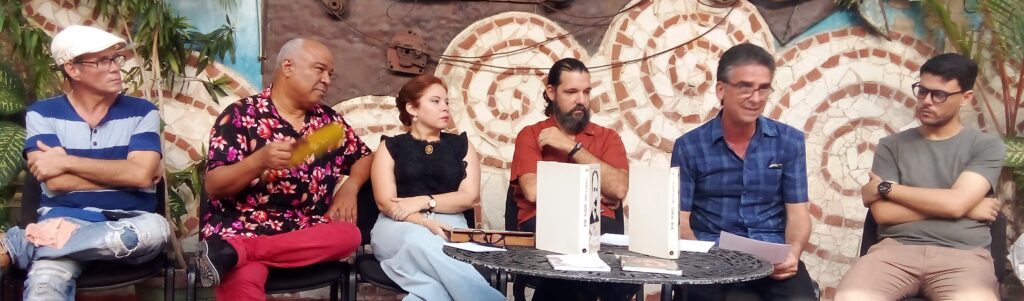
Various analyses and evaluations of the dramatic poem Abdala by José Martí were offered from their own experiences by the panelists gathered this May 18 at the House of Scenic Memory to commemorate the 131st anniversary of the fall in combat of Cuba’s National Hero and International Museum Day.
Poet and journalist Pablo G. Lleonart, a specialist at the institution, established the concordance between Nubia and Cuba, which for him constitute two forms of the same concern.
«When the character defines the Homeland, he does so very precisely. The Homeland is not the soil or the landscape. It is an active relationship in the face of oppression. This implies something important. The Homeland is not given once and for all; it must be constantly defended.
«The central conflict of the work and his mother can also be read as: My mother cries, Nubia demands of me. This is not only a conflict between the private and the public; it is also the moment in which the individual goes through his own night: doubt, pain, tension, and duty. Abdala makes a decision, but the work reveals the cost of that decision.»
Luis Ernesto Martínez, researcher, historian, and vice president of CITMA in Matanzas, delved into some of the circumstances that determined the possibility of knowing the poem that the Apostle wrote at only 15 years of age.
«Much has been written about Abdala, and everything seems to indicate that it will continue to be written for a long time to come. Abdala was published in the newspaper La Patria Libre in Havana on January 23, 1869. This was the only issue of that newspaper ever published.
«It is very rare to find in Cuba and in the world a work written by someone at that age that has had such significance. It was, effectively, a youthful text, even childish for those who follow certain psychological classifications, or that of an adolescent; it demonstrates the solid love for a Homeland eager to be free that José Martí already felt.»
«The play or dramatic poem — the categorization does not matter here — had an agonizing coincidence with the author’s later life and is therefore perhaps a premonitory scene of his own redemption.»
Abel González Fagundo, a specialist at the House, offered a personal perspective on the text, focusing on the study of Abdala as a germinal structure of José Martí’s ethical and aesthetic thought.
The poet referred to the eight-scene dramatic poem as a generational manifesto in which the conflict between personal love and love of the Homeland is established.
«We are faced with a text conceived for reading and interpretation rather than for performance, but which contains the seed of a poetics that transcends mere poetic demand to embody a profound meditation on the ultimate reasons for human existence.
«It can be classified as warlike, patriotic. We are not dealing with the exaltation of the lyrical, introspective ‘I,’ but rather with the construction of a ‘we’ that projects itself as a collective subject of history.
«The dramatic resources employed by the young Martí already reveal a remarkable sophistication for his age. The political and poetic allegory — that Nubia, which is Cuba without naming it — constitutes a mechanism to evade the colonial censorship of the time and also an aesthetic gesture that universalizes the conflict.
«The setting in Africa also allows for a revolutionary gesture for its time. For the first time in Cuban letters, at least as far as I know, a Black hero embodies the highest values of patriotism.»
From his deeply Martían perspective, actor, researcher, professor, and director of Teatro de las Estaciones, Rubén Darío Salazar — National Theater Prize winner — expressed that professional theater has had beautiful approaches to Martí’s work through children’s productions such as Los dos príncipes, Los zapaticos de rosa, and Nené traviesa.
However, only once from the professional realm has the challenge of bringing Abdala to the stage been undertaken. It happened in 1995, under the direction and expressionist aesthetic of Armando Morales, in a production that vindicated both the text and the staging.
«I trust that Martí is much more than that torch march on January 28. The greater task is truly to house in the heart of every child, young person, or adult the true essence and divine purpose of José Martí.
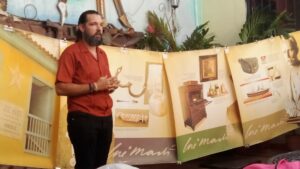
Reynaldo Perera de Armas, researcher, historian, and director of the project Cuentos de una casita (Stories of a Little House), detailed the context in which José Martí wrote Abdala, specifically the Havana atmosphere of the late 1860s in 19th-century Cuba.
«Unfortunately, Martí died at age 42. If he had not died at Dos Ríos, perhaps Cuban history would have been totally different. Abdala is not a mere poem. Perhaps if we all read a little and understood better and brought Martí into our being, we would have a much better nation than the one we have now and than the one we want it to be.»
For her part, actress and oral storyteller Dayana Deulofeu systematized how the evolution of the thought of the most universal of Cubans is evidenced through his literary production and his praxis.
«There are those who say it is an innocent poem, that it has an innocent vision of hatred for the enemy, of war. Very shortly afterward, that same boy wrote something else: Political Prison in Cuba. There is nothing in Political Prison that goes against what he placed in the poem.
«There are texts in José Martí’s work that are evolutionary. Juan Marinello said that certain ideas of Martí were ‘a unity on the rise.’ Among them is the Homeland, one of Martí’s broadest and deepest concepts.
«I believe that what does change in Abdala with respect to Political Prison is that first Martí speaks of an invincible hatred, and then he endures a cruel, ruthless prison. The evil he experienced was so overwhelming that it would have justified that sixteen-year-old boy, upon leaving that place, spitting hatred — but nothing is further from hatred than Martí’s writing from prison.»
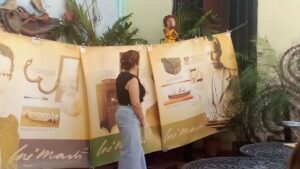
At the conclusion of the panel, Perera and Deulofeu explained their experiences as protagonists of Cuentos de una casita, a project that seeks, through 21 large-format images of José Martí’s birthplace, to bring to different parts of the country the objects treasured in the house on Paula Street.