
Concepto: A Poet’s Daily Return to Martí
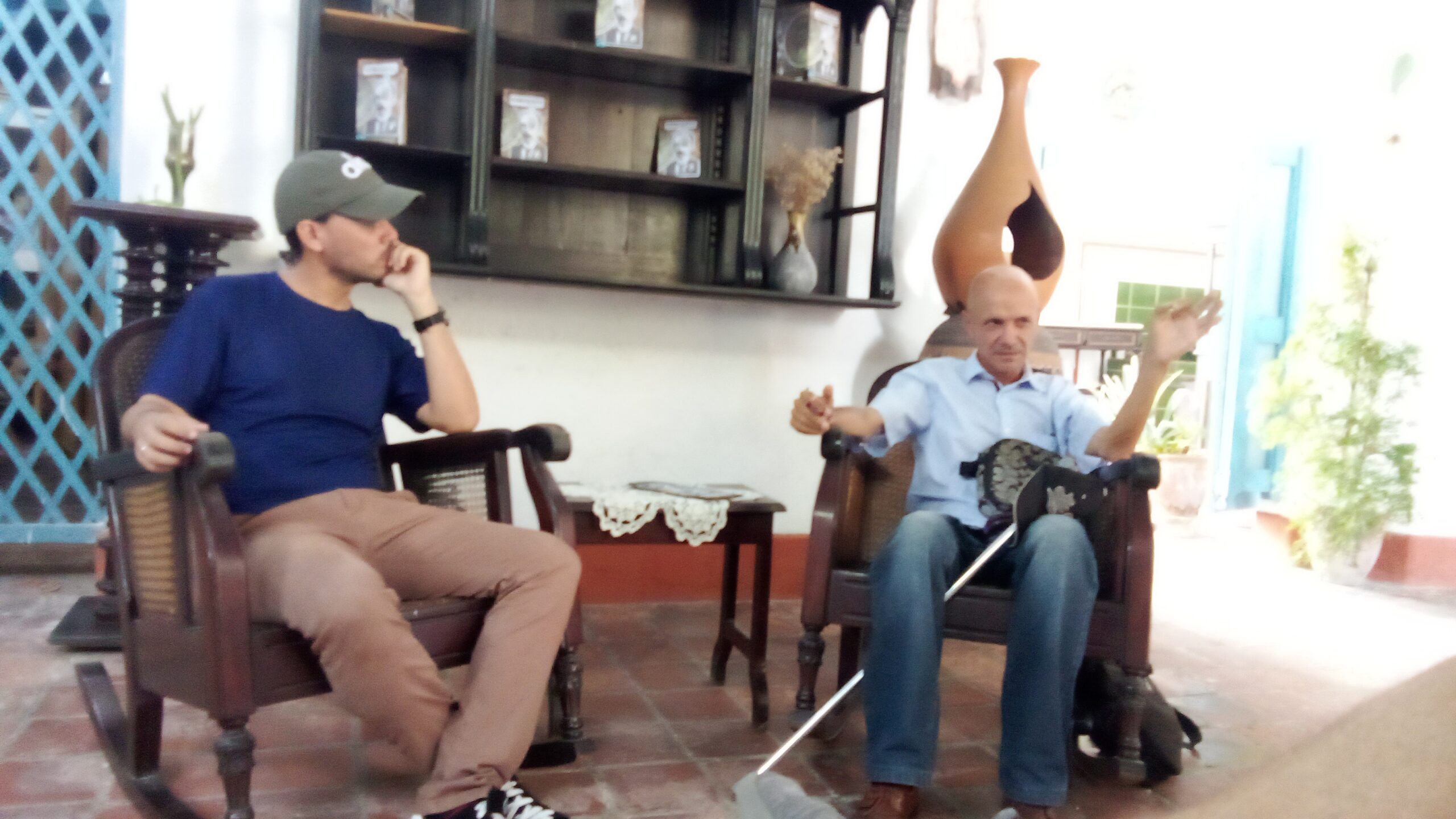
How much can it mean for a country to defile a symbol? What would be the social, political, and patriotic cost of outraging one of its most representative and legitimate cultural icons? How to respond to the disgrace of a Martí behind bars, eaten away by dust, neglect, and disrespect?
The image captured by Gaudencio Rodríguez Santana’s lens felt like the child of an immense apathy on the part of those who should have protected the portrait containing one of the most authentic paradigms of Cuban history and culture.
The poet, deeply Martían as he is, scandalized and disappointed, immortalized that institutional outrage, first in the photo. Then the poem was born, presented at Ediciones Vigía.
 «The poem ‘Concepto’ arises from a painful discovery I made of a certain image of Martí that does not represent him. It’s not that I’m thinking of a hieratic Martí, the one from park statues or the white one from schools, but rather a human Martí.
«I sent the photograph to a friend, and she recommended that there was a poem there, and the poem truly came out. José Martí should not be abandoned, and from that image of neglect, it addresses how we can rescue him. That image I saw is regrettable.»
«Concepto» was born from pain and shame in the face of an image that seems less like a portrait than a symptom, according to poet and editor Pablo G. Lleonart at the presentation; however, the poet does not refrain from extending the complaint to these dark and gloomy days.
«‘Concepto’ refers to what society is, what this era is because, more than talking about Martí, it talks about an era that is truly painful, full of many lacks, many sorrows, many ruptures.
«I could mention only individual ruptures, but personal ones coincide with the ruptures of others. The poem attempts to poeticize that pain, although sometimes the images of reality drown out poetry or appear in the poem even before they appear in real life, and that is something I wanted to put into it.»
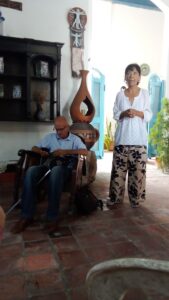 The poem does not discuss Martí, said the author; it works between the symbol and a latent reality. In a different way, the poet returns again and again from the sensitivity of his verses to take refuge under the mantle of the National Hero, the man of flesh and blood.
«I seek for us to see that Martí who needs to be rescued, the one of ‘with everyone and for the good of all,’ and although it is painful, reality is before our eyes. I propose revisiting and rescuing our Martí, a Martí who hurts, but who is ours, not the one of slogans or quotes, a true Martí.»
About «Concepto,» narrator, playwright, and critic Ulises Rodríguez Febles highlighted that it is «a poem born from a photo, from an event, from how Martí lives in some and is dead in others, and yet his powerful, unquenchable light ignites the multiple paths of everyone’s Homeland.»
With design by Marialva Ríos and editing by Agustina Ponce, the presentation of the chapbook «Concepto» at Ediciones Vigía was added to the commemorations of the 131st anniversary of José Martí’s fall in combat.
CONCEPTO
Behind the dirty glass and in abysses of neglect
lies the sacred face, the image of the hero
in the perpetuity of memory.
In that image of time
there is a cage, iron bars trap
the stern face, the exact gesture. And the stenches,
to what sacred part of his war do they summon us?
There is homeland in the knife that cuts the orange
and the useless son who watches others
counting coins, and sits at the table
to eat unhappy silence
while the hero remains in his iron cage,
his sullen face and broken gaze.
I march with the others and see the days
as if they were a strange succession,
as if no one else understood
the still gesture, the true reality
that unravels like a tired man.
Too late I understood the imprisoned man, the soldier
in a man’s suit, crumbling on the cardboard
against the undeniable solitude of dust.
Trapped behind the dirty glass, in the worn-out
surprise of the sheet, among the irons
that once bruised his ankle, in the stench
of perfectly accumulated urine,
and in that truth they keep under lock and key
as if everything that represents us in solitude
were a simple fallacy to forget.
Behind the glass, like a solemn fabrication,
the hero watches us. His face silently delivers diatribes
accompanied by moisture; but how strongly he burns
with the small eyes we see
sink into the horizon. And on the horizon
another country appears, indifferent to those who go
counting their coins to alleviate hungers.