
A Tourism Union That Faces the Challenges

Several processes that are decisive in the life of the Cuban working population are underway in the collectives of production, service provision, and the budgeted sector, and the leisure industry is no exception, maintains Julio Enrique Morales Verea, general secretary of the National Union of Hotel and Tourism Workers (SNTHT).
The union leader told the newspaper Trabajadores that a moment of particular relevance has been the training around the 176 economic and social transformations, especially the 13 measures concerning the sector, covered in thematic axis 17; although, he reasoned, truth be told, the others are in some way related to the activities of the Ministry of Tourism (MINTUR).
The important thing, he suggested, is to continue explaining to the men and women of hotels and extra-hotel entities the business opportunities that have been evaluated, what has been approved by MINTUR’s leadership, by the business groups and national companies.
He considered the preparation received by the agency’s cadres to be an advantage.
It was directed to take advantage of the scenario of union assets to equip grassroots leaders with the contents before reaching the meeting with the workers.
Morales Verea insisted on conveying the real possibilities of each center to achieve greater efficiency, on how commercialization will be managed, how the new payment systems and salary scales will be approved, according to the financial situation in each collective.
He suggested paying the maximum possible attention to aspects such as the updating of the regulation for the distribution of profits, and other destinations such as the repair, construction, or acquisition of housing, the fund for moral and material stimulation, and others that foster the entity’s development such as the training and preparation of cadres and workers — something that must be a priority, he stressed.
«We also face the process of drafting the economic plan and budget for 2027, at a complex moment due to the number of closed hotels, others with compacted services, and a number of intermittent workers in the destinations.»
Morales Verea mentioned the adoption of measures so that in the closed facilities they discuss or analyze at least the fixed expenses with those who are there preserving those accommodations, until the income plan can be examined, due to the uncertainty of not knowing when they will be able to open for operations.
He said the discussions must be tempered to the transformations themselves, due to the changes in management models, which is a challenge, he considered, taking into account that workers must know how operations will be carried out from now on. This is also a great challenge for the union movement, he emphasized.
A fundamental chapter is the one referring to the new Labor Code, collective bargaining, and the formation of the General Guidelines and Collective Labor Agreements.
There already exists a diagnosis of where guidelines are signed with the business and budgeted system at the Ministry, and where the national and provincial ones will correspond.
On this aspect he again insisted on the preparation required of union leaders to be able to negotiate well, and also in the case of the workers who will later have to approve the CCT, after it is made known and generates the corresponding debates.
He stressed that the assemblies of members and workers themselves must continue to be strengthened as a mechanism of real participation.
Morales Verea acknowledged that the organization’s influence is cardinal to ensure success in each of these processes — a good way, he held, to greet October 28, when we will attend the 31st anniversary of the founding of the SNTHT.
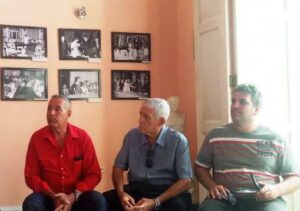
Cover Photo: Julio Enrique Morales Verea insists on the role of the union before the new economic and social transformations.
Photo: By the Author