
Fidel, Great Lover of Sports
They say that Fidel in his youth was a decent baseball player. There is a great number of games, even published by the press, in which he took part against quality teams, most of them after the revolutionary triumph.
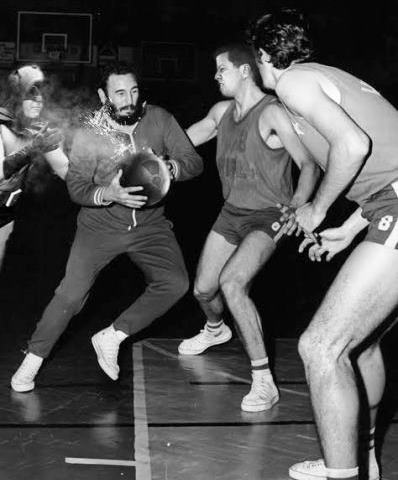
Although many agree that he was not a bad ballplayer, where he displayed the most quality was in basketball.
I heard anecdotes from some friends from Cárdenas who were studying Medicine at the time, that Fidel would challenge them to «la botella» — better known today as three-on-three basketball. The Leader of the Revolution would show up late at night to tell them he was waiting for them at the court to «shoot some hoops.»
Another witness to those duels, current engineer Víctor Cantera, told me that there were countless occasions when Conrado (Guamuta) Pérez and Alejandro Urgellés (deceased) justified their absence from classes due to these games, played in the early hours of the morning. They said it was not easy for them, since Fidel demanded that they «guard him hard.»
At his request, they even put together a team called «Cañeros,» in which he was part of the roster. Also playing in these «guerrillas» were José Llanusa, Mario «Risita» Quinteros, Casimiro García, Fabio Ruiz, and others, and they would face the youth basketball team, almost always late at night.
But it wasn’t only these sports that the Leader of the Revolution practiced; spearfishing, fishing, soccer — in which he even represented the then Belén College — volleyball, shooting, and swimming also saw his presence.
Fidel’s Presence at Palmar de Junco.
The story of Commander Fidel Castro’s commitment to rebuild the Palmar de Junco stadium in Matanzas began on January 7, 1959, when the Freedom Caravan arrived in this city.
That day, in response to a demand from the people gathered at Libertad Park to fix the facility, he said that «it was embarrassing that a city with so much history did not have its sports field in good condition.»
Although some time had to pass due to legal procedures for the purchase of the stadium from its apparent owner, Mrs. Matilde Moenk, Fidel was aware of the details, as published in the book Orígenes del béisbol cubano: el Palmar de Junco by Licentiate Alfredo Santana.
In a meeting held in October at the Matanzas delegation of the National Institute of Agrarian Reform (INRA), he took advantage of the presence of several provincial leaders and spoke with the delegate of Public Works at the time and the president of the local Heritage to outline the purchase and renovation strategy for the facility.
On November 25, 1959, the municipal government acquired the stadium, and on December 4, Fidel returned to Matanzas for work matters, including checking on and starting construction work at Palmar de Junco.
One day later, Commander Universo Sánchez, leading a brigade of 80 Rebel Army soldiers, undertook the remodeling task, and on February 6, 1960, they re-inaugurated the stadium with a game of the Cuban Professional League between Almendares and Cienfuegos.
That day, nearly ten thousand people witnessed the contested match in which Cienfuegos prevailed in eleven innings with a score of 3 runs to 2, remembered as one of the great duels of that season between Miguel Cuellar for the Alacranes and Pedro Ramos for the Elefantes.
These are historical facts of Fidel’s mark on Palmar de Junco — declared a National Monument on July 24, 1991 — little disseminated, which could not be missing on this 100th anniversary of his birth.