
Two Gazes at the American Continent in the Same Space at the Matanzas Photography Festival
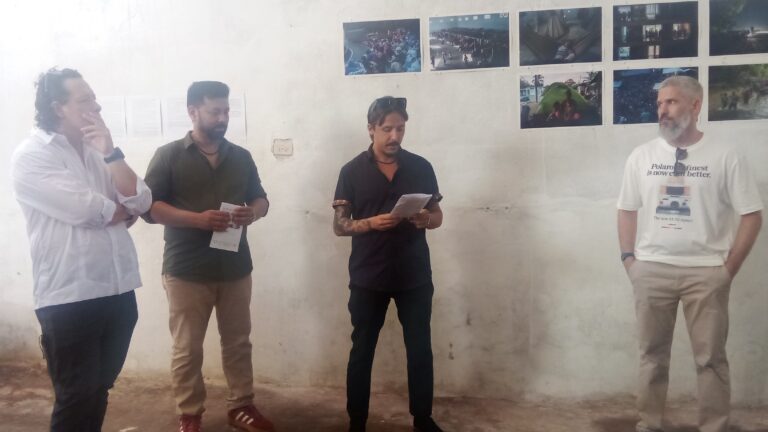
The gallery-workshop of Osmany Betancourt, «Lolo,» on Narváez Street, hosted the inauguration of two exhibitions whose themes differ but find common ground regarding the region where they take place.
Terra, a solo exhibition by Brazilian Anderson Coelho, is a photographic essay that revolves around a common axis: the Amazon as a territory of dispute, resistance, and transformation, and contributes to the understanding of that vast territory in Brazil.
«In this work we seek to show the Cuban public a little of the conflicts and distances that the Amazon experiences, how people are, how they live, their conflicts, the harvesting of açaí fruit, a fruit that is very common in the Amazon region and that is part of a global production chain.
«I seek to tell the fragility of those people who have a kind of organic life within the forest. I intend with this display to present a little of what the Amazon is with its mosaic of stories and situations.»
According to curator Caridad Blanco de la Cruz in the words for the catalog, «Coelho has recognized as the great work of his life photographing the Amazon. His bond with it led him to delve not only into its different territories but also to expose a careful narrative and visual, political, social, and environmental embroidery about that major zone of Brazil.»
Darién, born in one of the most inaccessible places on the planet and the densest and most impassable tropical jungle on Earth, «is a story, in the words of Blanco de la Cruz, based on powerful images on an extremely sensitive subject, such as human migrations today and the crisis they represent.»
«Between 2021 and 2024, more than a million people crossed the Darién jungle. Thousands died there, but many others managed to reach the United States and now have a life in this place.
«The crossing can take five, seven, perhaps ten days, and it is a toll of pain and death in which people die swept away by river currents, dehydrated; if you fracture a foot and cannot walk, you die because there is no possibility of assistance.
«It is a very difficult scenario, but for me it is a display of both the tenacity of the people who decide to migrate and the neglect of the whole world in turning to look the other way, with people who lost everything to seek a dream for themselves and their families.
«I feel that Darién is only a display of how humanity turns a blind eye and tries to look the other way when we have brothers and sisters, human beings, suffering in other latitudes,» reflected Federico Ríos Escobar, Colombian photographer.
Darién arose as the result of photographing for four years thousands of people on their journey through one of the most dangerous itineraries in the world in search of changing their destinies, motivated by the lack of opportunities, the search for economic improvement, political persecution, violence, oppression, wars, natural disasters, health crises, or humanitarian catastrophes in their countries of origin.
The exhibition, beyond the process many avoid talking about, looks inside the families and people who face extreme situations, physical challenges, dangers, and unspeakable adversities in their eagerness to reach the United States, in a race where hope becomes a currency in the face of fear, despair, survival, or death.
This Saturday, FOTOCANÍMAR’s proposals continue with the lecture «La imagen indisciplinada» (The Undisciplined Image) by Ira Kononeco at the ACAA, and the screening of the documentaries Al otro lado de la esperanza (On the Other Side of Hope) by Néstor Núñez and Cinco vistas de una realidad (Five Views of a Reality) by Leonardo Rego and Frank Batista.
Sunday will close the second chapter of FOTOCANÍMAR with the workshop «La revolución inconclusa» (The Unfinished Revolution) by Chilean Adolfo Mesías at Cuarto Rojo in the Office of the Curator, while the closing is scheduled for six in the evening at the Biscuit café-theater.