
10-Kilogram Mesenteric Cyst Removed at Matanzas Pediatric Hospital
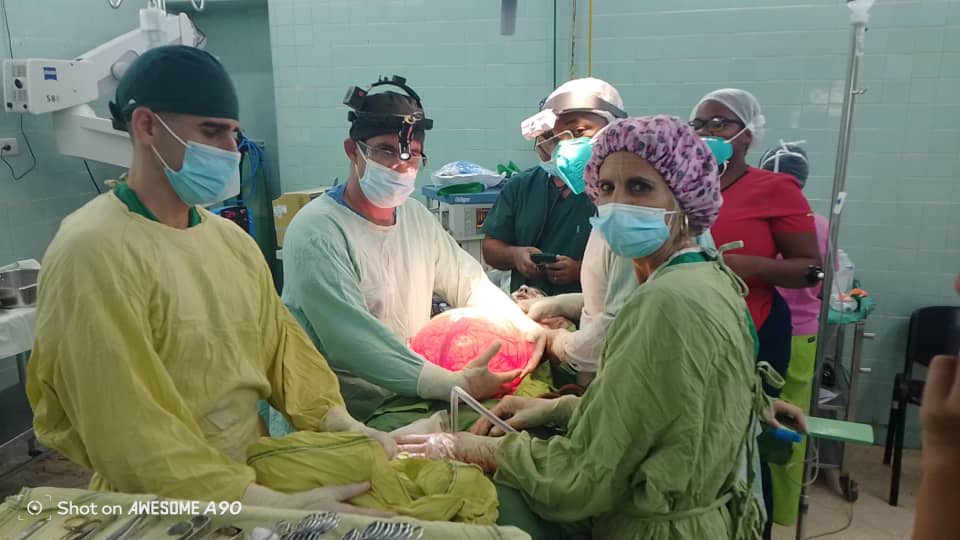
At the Eliseo Noel Caamaño Pediatric Hospital of Matanzas, the extensive knowledge of the medical team was once again demonstrated when they successfully performed a complex surgical intervention to extract a large cyst from an adolescent.
Once extracted, it was confirmed that the cystic mass exceeded 10 kilograms, something that still amazes the health personnel who participated in the risky operation.
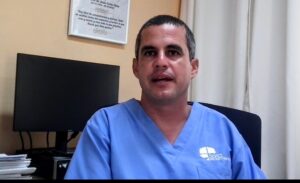
When the young but also experienced surgeon Javier Cabrera Reyes learned of the case and ordered the initial studies, he perhaps did not imagine that he would be facing a medical rarity, one of those that occur as a case in a hospital for every 250,000 patients.
The doctor and second-degree pediatrics specialist explains that the 17-year-old adolescent arrived at the Matanzas hospital from Jagüey Grande due to a significant increase in the size of her abdomen — «that is, a major abdominal distension.»
«She was received at our center, a study mechanism was set in motion, and the ultrasound revealed a large cystic mass that compressed all the organs of the cavity with displacement of the liver, spleen, and intestine.»
After performing a simple CT scan and another with contrast, the finding of the large intra-abdominal mass was confirmed, with high suspicion of a mesenteric cyst — a truly rare condition, the physician comments.
«A cystic mass that compressed almost all the organs of the abdominal cavity. We proceeded to immediately create a multidisciplinary working group and decided to intervene surgically.»
«The team of specialists,» adds Cabrera Reyes, «performed the abdominal approach through a midline incision and we found a mass of approximately 10 kilograms, with characteristics very similar to those described in the CT scan.»
The volume of the mesenteric cyst also compromised organs such as the right fallopian tube and the ovary.
The medical team managed to extract it without repercussions for the girl’s future health, something her mother appreciates with her heart still squeezed after the difficult days lived.
—
Yaima Beruvides looks at her little girl with tenderness, and also with a certain lump in her throat. She watches her rest in the Pediatric Hospital ward and thinks a little about waking her. She enjoys the serenity with which she breathes as she reaches deep sleep.
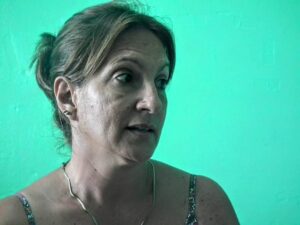
Rocío, her daughter, tries to protect herself from the brightness coming through the window with a small towel. The young girl rests without noticing that her mother has been talking about her for a while, especially about that fateful moment when an ultrasound revealed that something was not right in her body, that a cyst was growing inside her little girl, putting her life at risk.
The mother recalls that at first, when her daughter’s belly began to grow, she thought it was due to the father’s genetics, as he has put on some extra pounds over the years.
It was an exam in her native Jagüey Grande that triggered the first alarm signals.
The referral to the Pediatric Hospital was immediate, where a very professional team worked promptly from the very first moment.
«It was a major surgery, of great magnitude,» warns surgeon Javier.
«These abdominal masses, when decompressed, can cause severe risks of hemodynamic disorders in the patient.
«The anesthesiology colleagues play a very important role in this type of intervention, because when the mass is decompressed, the inferior vena cava increases its diameter and causes relative hypovolemia (blood loss).»
Thanks to the unconditional dedication of the team, composed among others by surgeons Diamercy Barceló and Raiko Freire, and anesthesiologist Guyen Demetrio, the operation concluded successfully.
Javier acknowledges that from a surgical point of view, they faced a large abdominal tumor compressing adjacent structures, which undoubtedly constituted a challenge to successfully complete the medical procedure.
The prior study of the case and the professionalism of the group of physicians minimized the risks.
The girl’s evolution has been satisfactory; she is in the open ward and within a few hours will return home.
—
Rocío Fagundo Beruvides takes her time to unstiffen after her mother’s call. She managed to fall asleep on a cool May afternoon.
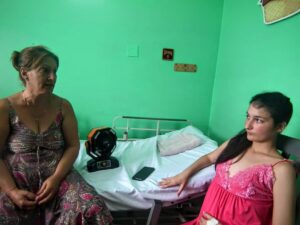
The brightness coming through the window blinds her eyes, which is why she tried to fight it with a small towel placed over her face.
Minutes later, upon waking, she manages to sit in a chair next to her hospital bed, not without some difficulty. The large scar causes her sharp pain as a typical phase of the postoperative process.
She wishes to return home to resume her drawings — her great passion to which she dedicates hours. Sometimes she prefers to listen to Guns and Roses as a form of inspiration and lets her imagination take flight.
She prefers to draw with pencil to achieve excellent chiaroscuro. She dreams of becoming a designer.
She recalls never feeling any symptoms; she only noticed that her belly grew and grew. When the studies were performed and she saw the anguished face of her mother, she understood that something was wrong and that she was in danger.
She has only words of praise for the hospital — both the doctors and the nurses; from all the staff she has received affection and words of encouragement.
Now she only worries that she will not be able to wear short clothes that reveal the scar. She will have to make some changes in her wardrobe and adapt her clothing to her new condition.
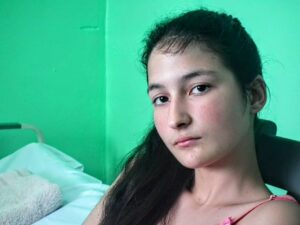
For now, she will learn to carry the large wound, and every time she rediscovers it in front of the mirror, she will surely think of how fortunate she has been, and she will also feel a deep sense of gratitude toward the staff of the Eliseo Noel Caamaño Pediatric Hospital.
Text and photos: by the author and courtesy of the medical team