
Cuba Closed Last Year with About 9.43 Million Inhabitants
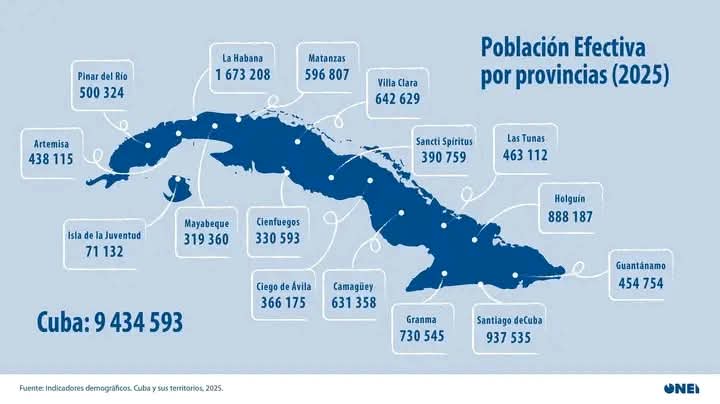
At the close of 2025, Cuba registered an effective population of around 9,435,000 inhabitants — some 9.43 million — which represents a decrease of about 313,000 people, approximately three percent, compared to the 9,748,000 counted at the end of 2024, as confirmed by a study from the National Office of Statistics and Information (ONEI).
According to the territorial breakdown, Matanzas occupies sixth place by number of inhabitants nationally, with about 597,000 residents. It is preceded by Havana, Santiago de Cuba, Holguín, Granma, and Villa Clara.
The capital, Havana, consolidates itself as the most populated territory, with around 1,673,000 inhabitants, being the only province that exceeds one million people. It is followed by Santiago de Cuba (about 938,000) and Holguín (nearly 888,000).
At the opposite extreme, the territories with the smallest effective population are the Isla de la Juventud Special Municipality, with about 71,000 inhabitants, followed by Mayabeque (319,000), Cienfuegos (331,000), Ciego de Ávila (366,000), and Sancti Spíritus (391,000).
The ONEI report indicates that the population reduction responds to a negative natural growth — with around 68,000 births against 136,000 deaths — as well as a migratory balance that subtracted about 245,000 inhabitants.
Furthermore, the population aged 60 and over rose to about 2,520,000 people, 26.7 percent of the total, while the average age stood at 45 years. Other figures of interest include Granma (731,000), Villa Clara (643,000), Pinar del Río (500,000), Las Tunas (463,000), Guantánamo (455,000), Artemisa (438,000), and Camagüey (631,000).