
Matanzas Canoeing School: A Lineage of Champions
Dawn breaks over the beautiful Matanzas bay. As the morning progresses, the youngsters from the Camilo Cienfuegos Nautical Base have already completed several exercise routines. Early in the morning, in the freshness of dawn, they navigated the river several times, later completing part of their training in the gym.
They chat among themselves and crack a few jokes. As is common among boys their age, they also stay connected to some social network on their cell phones.
Then they dedicate part of their break to petting the base’s mascot, whom they named Pulguita (Little Flea). She is a mixed-breed dog who wags her tail at everyone but becomes jealous of intruders.
When the clock strikes ten in the morning, they will head to the boathouse where they will do strength exercises. The coaching staff remains attentive to their preparation.
Looking inside one of the facilities, admiration grows for the many recognitions and medals obtained over the years. Such achievements seem unthinkable despite the condition of the boats, which show visible wear and tear.
But for the young rowers, the condition of their equipment does not seem to matter much. For decades, they have maintained a high competitive level, reaching first places in multiple sporting events.
The workout will consist of weights, rope climbing, and advancing in «cart» — as they call an exercise that simulates the effort made with the boat. They will do several repetitions of each modality.
In the room with old weight equipment, the metallic clatter of the discs will prevail. In the afternoon, they will return to training on the river.
At this nautical base, the double training sessions, among other preparation strategies, have allowed them to maintain top positions in the sporting events they participate in for more than 20 years.
For Lina Yusleidy Velozo, head of the discipline’s department, the results respond to the creation and consolidation of a Matanzas canoeing school.
«From the initiation process in the special area, we begin working with 9-year-old children who have aptitudes for this sport. Then a selection is made to integrate them into the EIDE (School of Sports Initiation). During that period, high-performance training begins.»
«Our sports center is characterized by dedication, where every talent that arrives integrates very well with the rest of the team. Everyone wants to be a champion, and for that they have an excellent group of coaches who also battle to achieve new victories each year.»
Such dedication has been rewarded abundantly. For 20 years, uninterrupted, they have led this sport at the national level, with absolute dominance of the School Games.
—
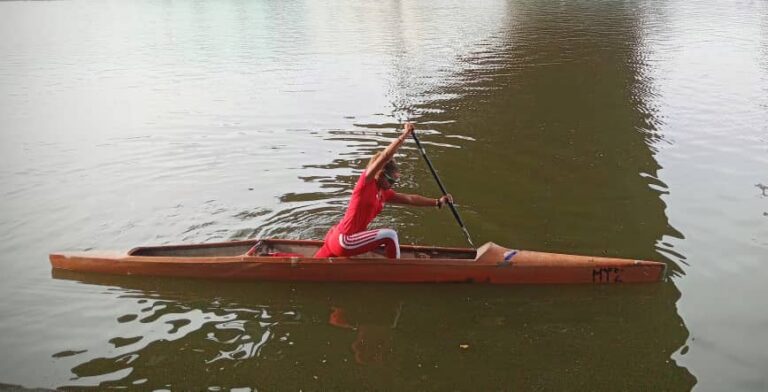
Young canoeist Delenys González likes to pose for photos after completing each competition. She asks her mother to take a picture of her holding the paddle as if she were performing one of those strokes that made her an undisputed champion.
At barely 15 years old, she achieved a feat rarely accomplished on the San Juan River: she stopped the clock at 2:09 over a distance of 500 meters.
The time achieved and the stability of her performance allowed her to enter the National Canoeing School.
She says she came to the sport by chance. Once, while playing with some friends on the riverbank when she was in fourth grade, a coach approached her and asked if she was interested in the sport.
Days later, she went to the special area, and over time she began training enthusiastically until she became a canoeing prospect in the country.
When she enters the river for training, she thinks of nothing else. She feels that no problem overwhelms her. «It’s absolute freedom.»
«I enjoy competing, and every tenth of a second I manage to shave off fills me with joy and drives me to train with more dedication and seriousness.»
However, the suspension of the National School Games was devastating news for the coaching staff and athletes.
The preparation period would be cut short, because medals and the podium serve as the epilogue to the intense training stage during the school year.
That is why the teaching staff designed the «Controles» (Controls), a sort of competition among students so they do not lose motivation, according to teacher Lina.
«That way they will remain focused on their training with the desire to continue being competitive athletes with great aspirations to achieve new titles.»
—
One afternoon in early June, under the Tirry bridge, the coach stands with the record book where she will record the times achieved by each competitor.
500 meters away, the youngsters position themselves, waiting for the voice that will announce the start of the race.
On the Narváez Street seawall, several parents also gather — a fundamental link in the formation of future champions.
The canoes advance over the gentle current of the San Juan. The frantic shouting of a mother cheering for her daughter can be heard. It seems she is rowing alongside her. Or at least she wishes she could.
The teacher waits under the bridge, watching the stopwatch. Just as the boats pass, she stops the clock and notes the time achieved.
Then she will correct some mistake of her students, call attention, or praise the most outstanding one.
«Many improved their personal marks,» she comments, while adding that if they were to compete today in a national event, they would step onto the podium. They exhibit significant records that demonstrate that at the Matanzas nautical base, the lineage of champions will continue to be fostered.