

Ulises Rodríguez Febles: «The Author Must Be a Reflection of His Time»
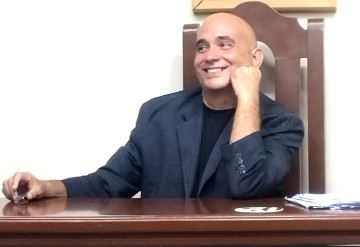
For playwright, writer, and critic Ulises Rodríguez Febles, theater must indisputably reflect the realities of an era. That is why his works address, question, explain, and reflect on the phenomena of these times.
Feminicidio, the text with which the director of the Casa de la Memoria Escénica earned the Santa Camila de La Habana Vieja grant in 2025, connects with a problem that has worsened in Cuban society in recent years.
«In reality, it is a work I had already done quite some time ago and it is in another process, especially synthesizing the number of characters so that I can then work with four actors.
«A lot of work was done on the theme, as it was completely rewritten and reinvented. It is a work still in process that speaks of femicide, a phenomenon that is hitting us, not only in Cuba but in several latitudes, especially in Latin American countries, where the number of women killed violently is striking; therefore, putting it on stage and emphasizing that was important.»
Written as a psychodrama, the work features characters taken from classical theater, an element that seeks a dialogue between past and present. «Agamemnon and Clytemnestra, Orestes and Electra, that is, brother and sister, and the two grandmothers, who are the mothers of Agamemnon and Clytemnestra.
«In the classic story of the Oresteia, it is Clytemnestra who kills Agamemnon, but here we have inverted the story and play with all of that: Agamemnon kills Clytemnestra, therefore it addresses the theme of femicide and violence.
«It was also about the relationship of that destroyed family, how they can live with the murderer of their mother, for example, the children, and it questions many things about how sometimes warnings are given about the danger women under threat may be in, possible victims of femicide, and generally no measures are taken, and it is one of the great problems that exist, and then the violent act occurs, or after the violent act occurs, how the laws do not take into account the danger that this problem represents.»
Regarding the upcoming staging of Feminicidio, Rodríguez Febles offers details related to the characters. «It is a project we are working on that already has actors’ names. The character of Orestes will be played by Ray Cruz; Clytemnestra by Haydée Hart; Agamemnon by Renecito de la Cruz; Electra will be Ary Fonseca. After that first part of textual writing, the staging will follow. It will have set design by Frank David Valdés.»
Ulises, knowledgeable about the female universe, inquires into the substrata and implications of the violent death of women from a perspective that, without being realistic, explicitly exposes one of the excesses of our closest and most current reality.
«As I see theater and writing specifically, I believe that authors, through artistic recreation, have the responsibility to become a testimony of an era that is happening and that has its traumas, its conflicts, its stories.
«Clearly this is a work that is not in a realistic tone because it is approached through the classical world character with another universe, with other references, but the focus has to do with a reality that is marking us, that is constant: the number of women who die violently at the hands of men.
«It is a responsibility we must assume. I see no sense in writing if it does not have to do with how we are living, with our reality. There are those who evade it, but I believe dramaturgy is always thinking about conflict.
«Do not expect that a playwright will not constitute a reflection of reality, and reality is actually proposing the theme to us, proposing the characters, proposing the circumstances. The artist will investigate, delve into people, into what people feel, what people think, what people suffer.»
As a playwright and writer, from the ethics and truth that precede his writing projects, the author of texts such as El señor de las tijeras, Las últimas vacas van a morir, and Criaturas de isla feels committed and responsible for bequeathing to posterity the testimony of this time.
«It is that I am beating with reality because the author, if he is not removed from the world, if he is not afraid to say what he sees, if he is faithful to the people, to his compatriots, to his fellow countrymen, to the people who live in his era, must be a reflection of his time.
«We had to live here. We can know what Homer’s era was like through Homer, we can know what the Hebrew world was like and all those things that happened through what was told in the Bible. Literature is a reflection, whether we like it or not, of life, and for that life places you in a place and gave you a certain gift.
«I feel responsible and committed, and that often has nothing to do with what other people expect of one; that is, I write for the people, for the community, not to look good to anyone, and that does not worry me.»
The Santa Camila de La Habana Vieja grant, which began as a recognition for staging, is currently awarded to dramaturgical texts, which stimulates writing.
«It stimulates creativity, it stimulates people to collaborate on certain projects that can be carried out, and the grant also pays tribute to José Ramón Brene, an author not fully studied who deserves recognition in Cuban dramaturgy, an author whom many people admire, whose work people know in part.
«I believe it is a tribute to Santa Camila de La Habana Vieja, a key work from the early years of the Revolution, among other very important works by Brene, and the awarding of the Brene prize also stands out for his recognized contribution to the Matanzas and Cuban stage. These are ways of stimulating, promoting, making visible, and making creators responsible for their vision, and it is a contribution of UNEAC to writers.»
With acting and direction by Rubén Darío Salazar, National Theater Award winner, actors from Teatro de Las Estaciones offered a reading of Feminicidio last Thursday at the Casa de la Memoria Escénica, during the sessions of the José Jacinto Milanés National Poetry Prize.